
Centreless Grinding Machine in India
Centreless Grinding Machine
in India
Centreless grinding machines play a vital role in modern manufacturing, where dimensional accuracy, roundness, and surface finish directly influence product performance. In India's expanding precision engineering sector, industries such as automotive, bearing manufacturing, medical components, aerospace parts, and general engineering depend on advanced grinding solutions to maintain consistent quality standards.
Precision Where It Matters
A centreless grinding machine in India is widely used for high-volume production environments where repeatability, stability, and productivity are essential.
Precision grinding ensures components meet exact dimensional tolerances, critical for industries where part interchangeability and fit are non-negotiable.
Controlled grinding processes deliver consistent surface finish that directly influences product performance in automotive, bearing, aerospace, and medical applications.
Designed for production environments requiring repeatability and stability, centreless grinding supports consistent output without complex work-holding setups.
Continuous grinding capability and automation integration maximize throughput, reducing downtime and manual intervention across large-scale production facilities.
Scarlo Machines — Manufacturing Since 1976
Understanding Centreless Grinding Technology
Centreless grinding differs from conventional cylindrical grinding because the workpiece is not clamped between centers. Instead, it is supported on a work blade and positioned between a grinding wheel and a regulating wheel. This arrangement enables continuous grinding without complex work-holding mechanisms.
The grinding wheel performs material removal, while the regulating wheel controls rotational speed and feed rate. The interaction between these two wheels ensures accurate roundness and surface finish.
This process is particularly suitable for shafts, pins, rollers, valve components, and other cylindrical parts requiring tight tolerances.
Modern centreless grinding machines incorporate hydrodynamic spindle bearings, precision ball screws, servo-controlled infeed systems, and accurately managed dresser mechanisms. These features help maintain consistent geometry, minimize vibration, and ensure stable grinding performance, even at higher cutting speeds.
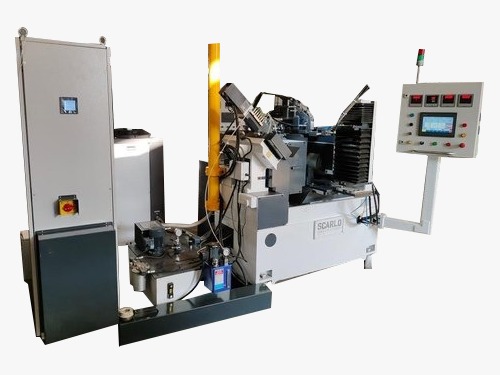
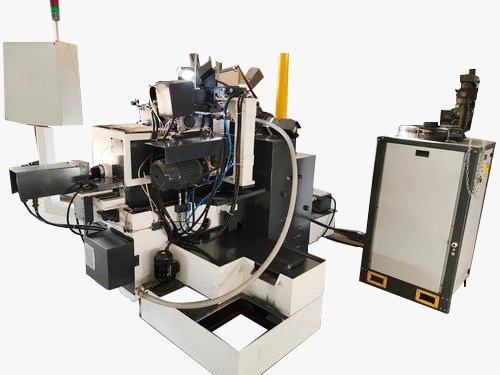
Scarlo Centreless Grinding Machine Model SG1 (6")
The SG1 (6") model is developed for precision grinding applications where compact machine dimensions and structural rigidity are equally important. It supports grinding ranges from small diameter components up to 100 mm, making it suitable for a wide variety of industrial parts.
Key capabilities include controlled grinding wheel peripheral speed, a regulating wheel speed range up to 210 RPM, and motor configurations designed for stable, uninterrupted operation. Both the grinding wheel and regulating wheel are supported on hydrodynamic Babbitt bearings, contributing to improved stock removal rates and enhanced surface finish. The machine features antifriction infeed slide systems with fine feed graduations for precise adjustments. Servo-controlled variants provide greater accuracy in infeed and diamond advance movements, allowing micron-level corrections during operation. Continuous lubrication systems, combined with temperature protection mechanisms, help preserve spindle integrity and extend machine life.
Machine Design and Engineering Approach
Centreless grinding performance depends heavily on structural rigidity and spindle stability. The machine base casting is manufactured as a single, rugged structure to reduce vibration and maintain alignment during operation. In larger models, twin grip spindle configurations further strengthen the mechanical framework.
Spindle lubrication systems are designed with dry-run protection and temperature cut-off mechanisms to safeguard bearings during prolonged grinding cycles. Ceramic-coated spindles and precision-ground ball screws enhance durability and ensure consistent, smooth movement.
In servo-controlled machines, antifriction slide systems paired with precision ball screws improve positioning accuracy and reduce backlash. This engineering approach supports high repeatability, which is essential for mass production environments requiring consistent output quality.
Automation and Integrated Feeding Systems
Automation plays an increasingly important role in Indian manufacturing, particularly where production consistency and labor optimization are priorities. Scarlo Machines offers integrated automation solutions designed to support continuous operation and reduce manual intervention.
These automation modules are configured according to component geometry and production requirements. Servo integration ensures synchronization between grinding cycles and feeding systems, improving throughput while minimizing downtime.
Applications of Centreless Grinding Machines
Centreless grinding machines are widely used across industrial sectors in India due to their efficiency in handling small and medium-sized cylindrical components. They are particularly suited for high-volume manufacturing where dimensional consistency is critical.
The ability to consistently maintain roundness, concentricity, and surface finish makes these machines indispensable in quality-focused industries.
Plant Capabilities and Manufacturing Control
Machine performance in the field is directly influenced by manufacturing quality and assembly precision. Scarlo Machines produces major components in-house to maintain dimensional accuracy and quality consistency. The facility is equipped with horizontal boring machines, CNC turning centers, milling machines, lathes, surface grinders, and cylindrical grinders. Dedicated specialists handle precision assembly to ensure accurate alignment of spindle systems and slide assemblies.
per month
produced in-house
manufacturing expertise
Optional Features for Advanced Requirements
Industrial users often require customization based on component size, production volume, or automation level. Centreless grinding machines can be configured with optional features to meet specific operational needs, including:
Choosing the Right Centreless Grinding Machine
Selecting the appropriate centreless grinding machine involves careful technical evaluation rather than simple capacity comparison. Manufacturers should assess key operational parameters before making an investment.
A properly matched machine enhances output consistency, reduces maintenance challenges, and supports long-term operational efficiency. Industrial buyers in India increasingly prioritize reliability, serviceability, and lifecycle performance alongside core machine specifications.
Maintenance and Operational Stability
Machines equipped with automatic lubrication systems for slideways and truing units reduce manual dependency and help maintain motion accuracy over time. Air-cooled heat exchangers and efficient coolant systems further stabilize the grinding environment.
Spindle oil temperature monitoring systems prevent overheating during extended operations. Regular inspection of dresser mechanisms and regulating wheel alignment is essential to maintain surface finish quality and dimensional precision.
Operational stability also depends on proper calibration and skilled handling. Servo-based infeed systems offer enhanced control and adjustment precision compared to conventional mechanical feed systems, supporting consistent performance in high-volume production settings.
Future of Centreless Grinding in India
India's manufacturing sector continues to expand, driven by automotive production growth, export-oriented engineering units, and increasing industrial automation. As demand for precision components rises, stable and repeatable grinding processes are becoming even more critical. Servo-controlled and CNC-integrated centreless grinding machines are gaining wider adoption in advanced facilities. Automated feeding lines and interconnected production systems enable consistent quality with reduced manual intervention. With tightening tolerance requirements, machine rigidity, spindle design, and thermal stability will remain central to performance standards.


