
Home Page Our Blog Regulating Wheel Tilt Angle in Centerless Grinding

Contact us for help?

Contact with us through our representative or submit a business inquiry online.

Contact Us

Regulating Wheel Tilt Angle in Centerless Grinding

Medical Oxygen Generator Plant


Regulating Wheel Tilt Angle in Centerless Grinding

Regulating Wheel Tilt Angle in Centerless Grinding


Introduction

The regulating wheel tilt angle is one of the most critical setup parameters in centerless grinding. By tilting the regulating (control) wheel axis slightly relative to the grinding wheel, the workpiece is driven axially for through-feed, stabilized in the grinding zone, and guided to achieve roundness, straightness, and surface finish. Optimizing this angle unlocks higher throughput with consistent quality.


Description

In through-feed centerless grinding, the regulating wheel both supports and drives the workpiece. A small tilt—typically within a few degrees—creates a tangential force component that feeds the part across the machine. Too little tilt reduces feed and may cause chatter or burn; too much tilt can induce taper, spiral lines, or loss of control. The ideal setting depends on part diameter, material, wheel grades, work-rest blade height, and desired stock removal. Properly set, the tilt angle improves tracking, stabilizes the workpiece trajectory, and balances productivity with accuracy.


Applications and Benefits

Applications Benefits
  • Through-feed grinding of bars, pins, shafts, and tubes in mass production
  • Automotive components: rocker pins, valve stems, transmission shafts
  • Bearing rollers and races requiring tight roundness & cylindricity
  • Fasteners and tool blanks where straightness and finish are critical
  • Precision machining cells integrating automated loading/unloading
  • Controlled axial feed for stable part transport and higher throughput
  • Improved roundness and straightness with reduced chatter
  • Lower dressing frequency due to steadier grinding forces
  • Reduced scrap and rework via repeatable, documented setups
  • Better surface finish from consistent workpiece trajectory

Key Setup Notes & Best Practices

  • Start Small: Begin with a conservative tilt (e.g., 0.5°–1.5%) and adjust in small steps while monitoring feed rate, part roundness, and thermal marks.
  • Coordinate with Blade Height: Blade height (center above wheel centerline) and tilt angle interact; re-verify line of action after any blade change.
  • Match Wheel Grades: Harder regulating wheels typically require less tilt; softer grades may need slightly more to maintain traction without smearing.
  • Watch for Taper: Excessive tilt can produce in-feed taper or helical patterns—dial back tilt or correct work support alignment.
  • Document & Repeat: Record angle, blade height, wheel specs, dress parameters, and achieved metrics for rapid, repeatable setups.

Where the Tilt Angle Matters Most

  • High-Volume Through-Feed: Small diameter bars/pins where consistent axial transport is essential to avoid dwell and burn.
  • Tight Roundness Jobs: Bearing & automotive parts needing sub-micron roundness benefit from carefully balanced tilt and blade height.
  • Mixed Materials: Stainless, tool steels, and hard alloys where traction and thermal control require precise tilt tuning.

Why Choose Us?

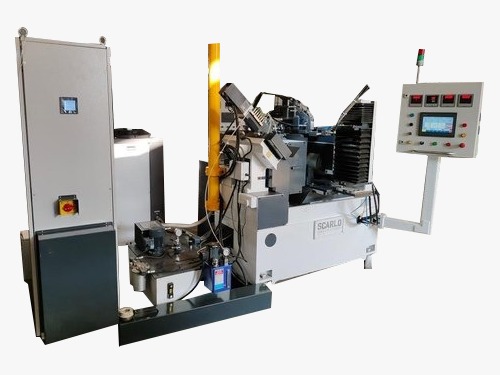
At Scarlo Machines, we engineer centerless grinders that simplify critical setup tasks like regulating wheel tilt angle. Our rigid machine base, accurate adjustment mechanisms, and application support help you find the sweet spot between speed and precision—so you ship parts that meet print the first time, every time.


Uses & Importance

Correctly setting the regulating wheel tilt angle governs axial feed, stabilizes the grind, and protects surface integrity. When combined with the right blade height and wheel combination, it shortens cycle times, ensures repeatable quality, and lowers the total cost per part across automotive, bearing, and general engineering production.


Manufacturer & Supplier Information

Scarlo Machines is a trusted manufacturer and supplier of centerless grinding solutions in India. We provide guidance on setup essentials—including tilt angle, blade geometry, and dressing recipes—so your team can reach target roundness, finish, and throughput quickly. Contact us for application support or turnkey solutions.

FAQs

1. What is a typical regulating wheel tilt angle range?
Most through-feed jobs run with a small tilt—often under a few degrees. The exact value depends on part size, material, and wheel choices. Start low and increase gradually while checking feed and part quality.
2. How does tilt angle affect feed rate and finishes?
More tilt increases axial feed and productivity, but too much can introduce taper or spiral marks. Balance tilt with blade height and wheel conditions to maintain finish and roundness.
3. Do I need to change tilt after dressing?
After heavy dressing or a wheel change, re-verify tilt and blade settings. Geometry shifts can alter traction and the line of action, impacting part tracking and finish.
4. What symptoms indicate incorrect tilt?
Signs include inconsistent feed, burn, chatter, helical lines, or taper. Reduce tilt if you see taper/spirals; increase slightly if parts stall or dwell in the grind zone.
5. How should tilt be documented for repeatability?
Record angle setting, blade height, wheel specs, dress parameters, and achieved tolerances to recreate the setup quickly on future runs.

Conclusion

Dialing in the regulating wheel tilt angle is central to stable, high-quality through-feed centerless grinding. With robust machines and expert guidance from Scarlo Machines, you can achieve predictable feed, tight roundness, and premium finishes at competitive cycle times.


Contact Details

Talk to our specialists today for tailored solutions and fast assistance.

Company:

Scarlo Machines

Phone:

+91 9825303532, +91 9099969410

WhatsApp: Chat on WhatsApp
Address:

C1-1, G.I.D.C. Estate, Opp. Ambica Nagar,Road No13, Odhav, Ahmedabad-382415, Gujarat, India


Filter Using Product Tags


Hydraulic Centerless Grinder Manufacturer| Hydraulic Centerless Grinder Supplier| Precision Hydraulic Centerless Grinder| CNC Hydraulic Centerless Grinder| Automatic Hydraulic Centerless Grinder| Industrial Hydraulic Centerless Grinder| High Precision Hydraulic Grinding Machine| Hydraulic Centerless Grinder Service| Affordable Hydraulic Centerless Grinder| Best Hydraulic Centerless Grinder| Precision Hydraulic Centerless Grinding Machine Supplier| Grinding Range| Maximum Length For Thru Feed Grinding| Maximum Length For Infeed Grinding| Grinding Wheel Size (Od X Wd X Id)| Regulating Wheel Size (Od X Wd X Id)| Grinding Wheel Peripheral Speed| Regulating Wheel Speed Range| Grinding Wheel Motor Power| Regulating Wheel Motor Power| Spindle Lubrication Pump Motor| Dresser Actuation Pump Motor| Slide Lubrication Motor| Coolant Pump Motor| Coolant Pump Displacement Capacity| Heat Exchanger Motor| Infeed Lower Slide Feed Graduation| Infeed Slide Servo Graduation| Ac Invertor For Grinding Whl Spindle| Ac Invertor For Regulating Whl Spindle| Regulating Wheel Tilt Angle| Regulating Wheel Dresser Diamond Offset Range| Grinding Wheel Diamond Advance| Grinding Wheel Diamond Advance – Servo| Infeed Servo Motor Ratings (Nm)| Dresser Servo Motor Ratings (Nm)| Total Peak Power Consumption| Total Machine Weight| Total Shipping Weight| Country Of Origin| Maximum Length For Infeed Grinding| Grinding Wheel Peripheral Speed| Regulating Wheel Speed Range| Regulating Wheel Motor Power| Grinding Wheel Motor Power 30hp / 40 Hp Opt| Regulating Wheel Motor Power| Spindle Lubrication Pump Motor| Grinding Wheel Spindle Lift Motor| Dresser Actuation Pump Motor| Slide Lubrication Motor| Coolant Pump Motor| Coolant Pump Displacement Capacity| Oil Chiller Unit Motor| Infeed Lower Slide Feed Graduation| Infeed Slide Servo Graduation| Ac Invertor For Grinding Whl Spindle| Ac Invertor For Regulating Whl Spindle| Regulating Wheel Tilt Angle| Regulating Wheel Dresser Diamond Offset Range| Infeed Servo Motor Ratings (Nm)| Dresser Servo Motor Ratings (Nm)| Total Peak Power Consumption| Machine Floor Size| Total Machine Weight| Total Shipping Weight|
quit