
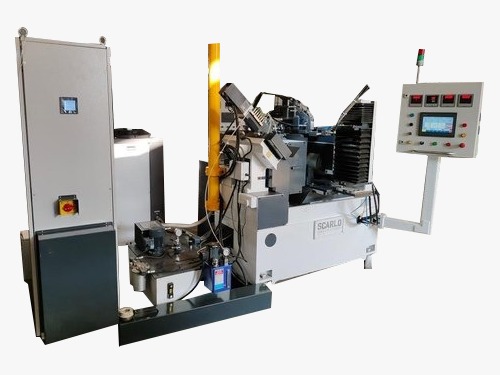
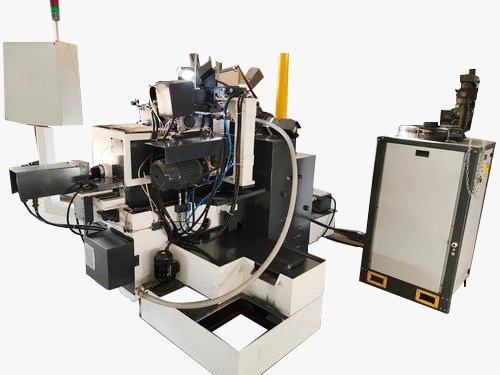
Regulating Wheel Dresser Diamond Offset Range

Regulating Wheel Dresser Diamond Offset Range
Introduction
The diamond offset range of a regulating wheel dresser defines how far the dressing diamond is positioned from the regulating wheel’s centerline or neutral axis during dressing. Correctly setting this offset controls the effective taper/crown of the regulating wheel, which in turn governs workpiece roundness, feed stability, and part-to-part size consistency in centerless grinding. This page explains what the offset range means, why it matters, typical ranges used on Scarlo centerless grinders, and practical guidelines for setup and troubleshooting.
Description
In centerless grinding, the regulating wheel imparts rotation and axial feed to the work. By introducing a deliberate diamond offset when dressing the regulating wheel, operators can generate a slight crown or taper. This shape compensates for loading and thermal effects, stabilizes the workpiece line of contact, and helps maintain straightness. Typical usable offset range is ±0.00–2.00 mm at the dresser slide (or equivalent angular/minute-of-arc at the dresser pivot), depending on wheel diameter, width, material, and process (through-feed vs infeed). Small offsets (0.10–0.40 mm) are common for precision through-feed of small bars; higher offsets (up to ~1.50–2.00 mm) may be applied for difficult materials, longer contact lengths, or to correct taper trends.
Applications and Benefits
| Applications | Benefits of Proper Offset |
|---|---|
|
|
Key Considerations for Offset Selection
- Wheel Geometry: Larger regulating wheels and wider contact widths often need slightly higher offset to maintain a helpful crown.
- Workpiece Length & Rigidity: Long, slender parts benefit from a mild crown (small positive offset) to prevent end taper.
- Material & Grindability: Difficult alloys or gummy materials may require higher offset for traction and stability.
- Process Type: Through-feed typically uses modest offsets; aggressive infeed may need tailored offsets to balance forces.
- Trend-Based Tuning: If parts taper small-to-large from entry to exit, reduce offset or reverse sign; if the reverse, increase offset appropriately.
Where It’s Used
- Automotive: Precision shafts, needle rollers, rocker pins—offset stabilizes rotation for micron-level roundness.
- Bearings & Industrial: Inner/outer elements and rollers where crown control prevents barrel or taper defects.
- Aerospace: Tight GD&T on superalloys—offset tuning helps maintain straightness without overloading wheels.
Why Choose Us?
Scarlo Machines designs centerless grinders with rigid dresser mechanisms and precision linear guides so your regulating wheel diamond offset is repeatable and easy to set. Clear micrometric scales (or encoder feedback), robust slides, and stable spindles ensure the offset you dial is the profile you grind—run after run.
Recommended Offset Ranges (Guideline)
Typical starting points on Scarlo machines (adjust per result):
| Scenario | Suggested Diamond Offset (at dresser) |
|---|---|
| Small bars (Ø3–12 mm), through-feed, carbon steel | +0.10 to +0.40 mm |
| Medium shafts (Ø12–30 mm), through-feed, alloy steel | +0.20 to +0.80 mm |
| Long, slender parts (L/D > 20), through-feed | +0.40 to +1.00 mm |
| Difficult materials (SS, Inconel), through/infeed | +0.60 to +1.50 mm |
| Correcting exit-large taper trend | Increase offset slightly or adjust sign until trend neutralizes |
Setup Tips & Troubleshooting
Quick Checklist
- Dress regulating wheel with the intended offset; verify on scale/encoder.
- Confirm regulator speed, inclination angle, and work-rest blade height (center above/below line) are per spec.
- For taper trends, change offset in small steps (0.05–0.10 mm) and record effect.
- Re-dress grinding wheel if changing offset significantly—maintain coherent geometry.
- Log wheel wear: as regulating wheel wears, offset effect may attenuate; compensate as needed.
Uses & Importance
The dresser diamond offset is a primary control knob for work stability and geometry in centerless grinding. It directly affects traction, roundness, and taper. Mastering offset selection reduces scrap, improves Cp/Cpk, and enables consistent microns-level accuracy in high-volume production.
Manufacturer & Supplier Information
Scarlo Machines supplies precision centerless grinders with robust, easy-to-tune dresser assemblies for regulating wheel diamond offset control. From small-bar through-feed to demanding aerospace alloys, our machines provide the rigidity and repeatability required for stable offset application and superior part quality.
FAQs
Conclusion
The Regulating Wheel Dresser Diamond Offset Range is critical for controlling roundness, straightness, and size stability in centerless grinding. With Scarlo’s rigid dresser design and intuitive adjustments, you can apply precise offsets, stabilize your process, and hit tight tolerances consistently—shift after shift.
Contact Details
Talk to our specialists today for tailored solutions and fast assistance.
+91 9825303532, +91 9099969410
C1-1, G.I.D.C. Estate, Opp. Ambica Nagar,Road No13, Odhav, Ahmedabad-382415, Gujarat, India
Filter Using Product Tags


